
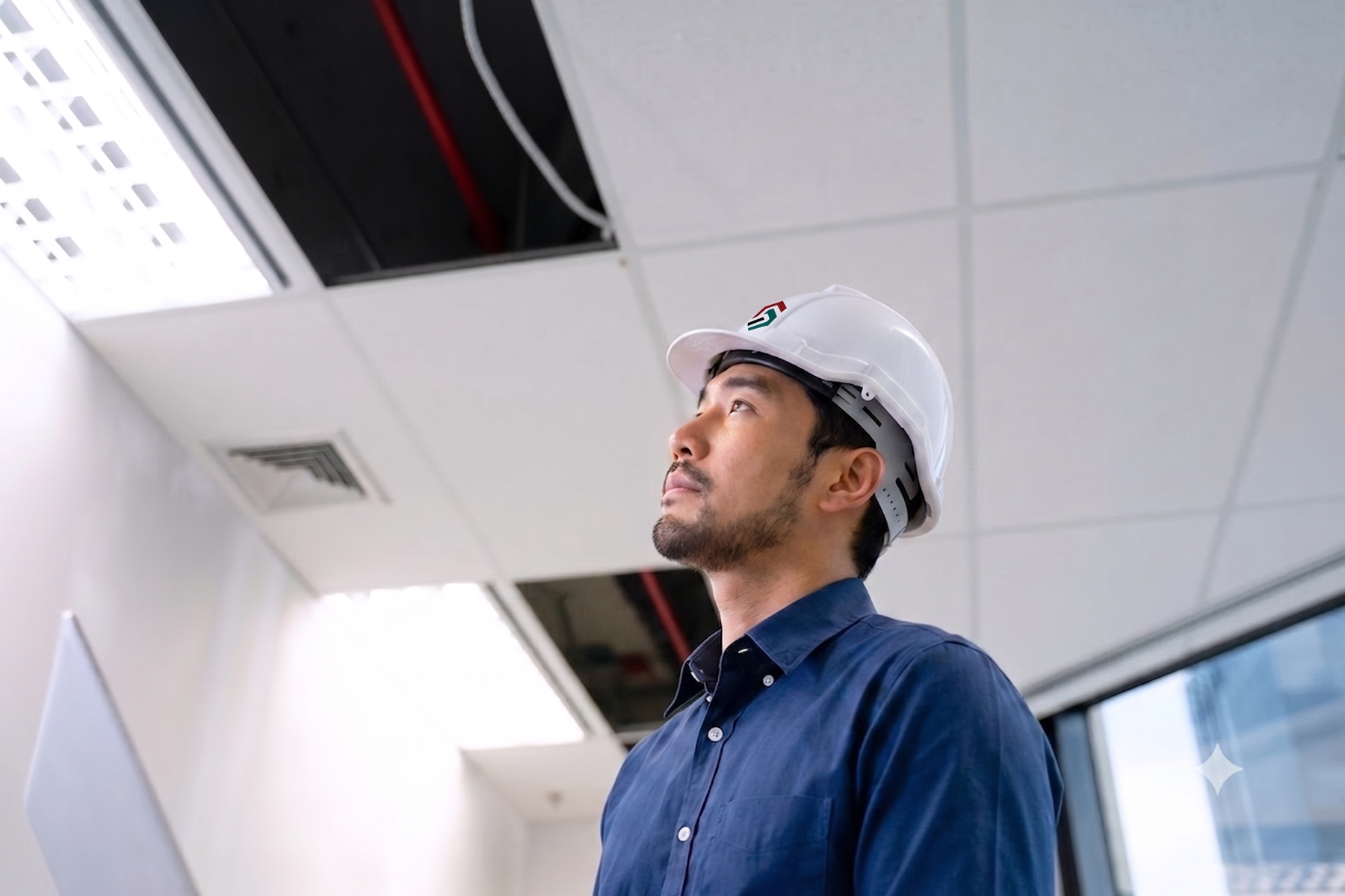
When clients engage an engineering consultant for a fitout or refurbishment, the conversation usually starts with the new design.
Where will the new air conditioning units go?
Can we relocate the amenities?
Is there enough power for the new tenancy?
How do we achieve compliance while keeping within budget?
They’re all important questions. But before we answer any of them, there’s one question we always ask:
Do we really understand the building we’re working with?
In our experience, that’s where the success of a project is often determined.
The Building Doesn’t Always Match the Drawings
One of the biggest misconceptions in existing building projects is that the as-built drawings tell the whole story.
They rarely do.
Over the life of a commercial building, tenancies change, plant is upgraded, services are rerouted, and maintenance teams make practical modifications to keep buildings operating. Not every change finds its way back into the documentation.
We’ve inspected ceilings where redundant ductwork occupies valuable space, pipework has been diverted around previous fitouts, and cable trays now sit exactly where new mechanical services were intended to run. Sometimes the drawings are remarkably accurate. Other times, they’re simply a starting point.
That’s not a criticism of previous consultants or contractors. It’s just the reality of buildings that have evolved over many years.
The Hidden Risks Above the Ceiling
Some of the biggest project risks aren’t immediately visible.
A ceiling space that appears generous on the drawings may already be heavily congested. Existing equipment may have little spare capacity. Access panels may no longer align with critical services, making future maintenance difficult.
These issues don’t necessarily stop a project. But discovering them during construction is far more disruptive than identifying them during design.
By investing time upfront to understand the existing conditions, the project team has the opportunity to make informed decisions before they become costly variations.
Site Investigations Are More Than a Compliance Exercise
At AGLK, we don’t see site investigations as a box to tick before design starts.
They’re one of the most valuable stages of the project.
Walking the site allows us to validate assumptions, inspect plantrooms, access ceiling spaces, understand how services interact and identify constraints that simply aren’t visible on a drawing.
Just as importantly, it gives us a better appreciation of how the building actually operates.
Buildings are designed for people, but they’re also maintained by people. A solution that works on paper still needs to be practical to install, maintain and operate over the life of the building.
Good Engineering Starts With Good Questions
One of the most valuable things an engineer can do isn’t produce drawings.
It’s to ask the right questions.
- Can the existing outside air system support the proposed occupancy?
- Is there enough ceiling space to route new ductwork?
- Will maintenance personnel still be able to access critical equipment?
- Can the existing infrastructure be reused instead of replaced?
These questions often shape the design more than the design itself.
Looking Beyond the Blueprint
Technology continues to improve how we design buildings. We have better modelling tools, more detailed BIM models and increasingly sophisticated software.
But none of these replace engineering judgement.
The most successful projects still begin with understanding the building in front of us, not just the drawings on our screen.
That’s why we believe existing services investigations aren’t simply an early project task. They’re the foundation for everything that follows.
Because before we can design what’s next, we need to understand what’s already there.
Key Takeaways
- As-built drawings are an important reference, but they shouldn’t be treated as the complete picture.
- Early site investigations reduce project risk by identifying constraints before design progresses.
- Understanding existing services leads to more practical, coordinated and buildable engineering solutions.
- Good engineering begins with understanding the building, not just producing new drawings.